
Nirvana
Solitude – Solace – Serenity
THE ELEMENTS
Everything in nature is made up of the five elements, viz. Space/Sky, Air, Fire, Water and Earth. This is an intended explanation of the complexity of nature. All elements that occur in nature, occurs because of fusion in stars. “Panchamabhuta”(https://en.wikipedia.org/wiki/Pancha_Bhoota) explains that every human body is made up of five elements. Each of the five elements has its own functions and characteristics.
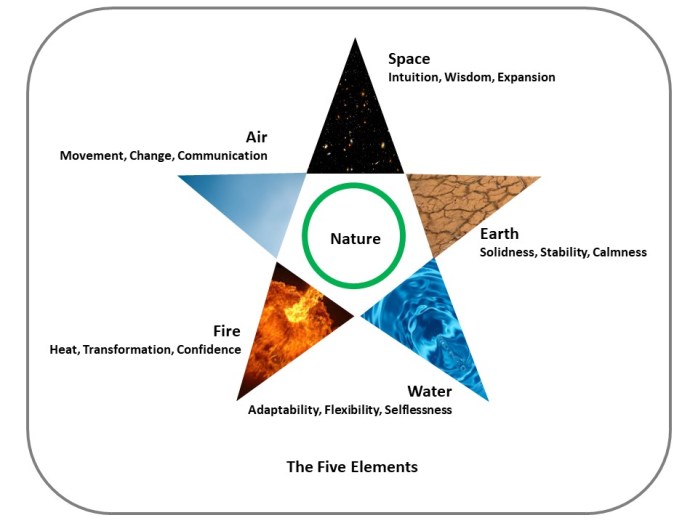
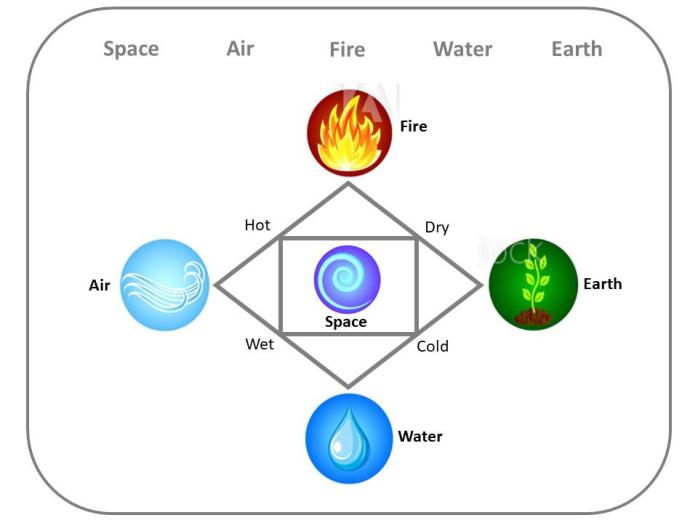
One needs to understand these elements to understand the issues in life, be it about mental, physical, financial, relationships or spiritual. Any imbalance in elements can lead to problems in any of the above mentioned areas. The only way out is to balance the elements.
SPACE/SKY/AKASH(Sanskrit)
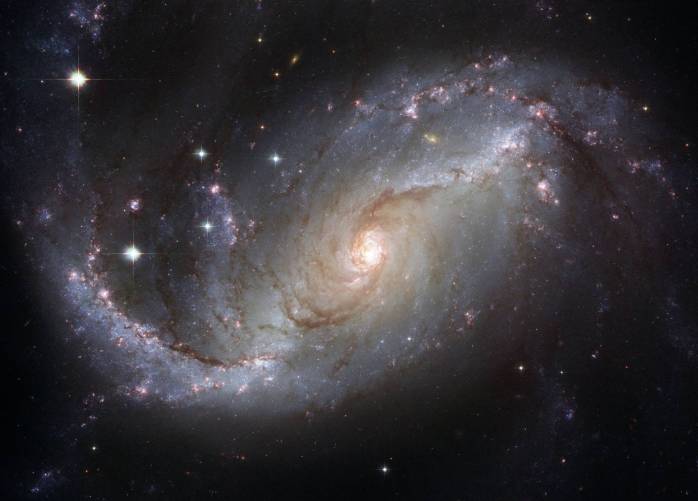
Space is translated as Akash in Sanskrit. Space is the medium of sound but is inaccessible to all other senses. And in human body Athma (Soul) refers to space. Air is a detaching element an enables co-existence of the two main elements, fire and water. The element of earth, binds fire, water and air in various proportions, which makes possible the formation of materials with different properties.
To find balance in life and with the life sustaining elements, one has to empower oneself. Where one has to first be aware and then self-correct and self-guide to equilibrium state.

Space defines the gap between any two things, e.g. joints, thoughts, relationships, work and so on. Without space our joints will start aching, mental balance will be lost, friction shall appear in work and relationships. So space defines the element of non-resistence.
EARTH/BHUMI(Sanskrit)

Our five senses, viz. hearing, smell, taste, touch and sight; the physical body with muscles and bones refer to earth. Earth also is synonymous with Prithvi (Sanskrit).
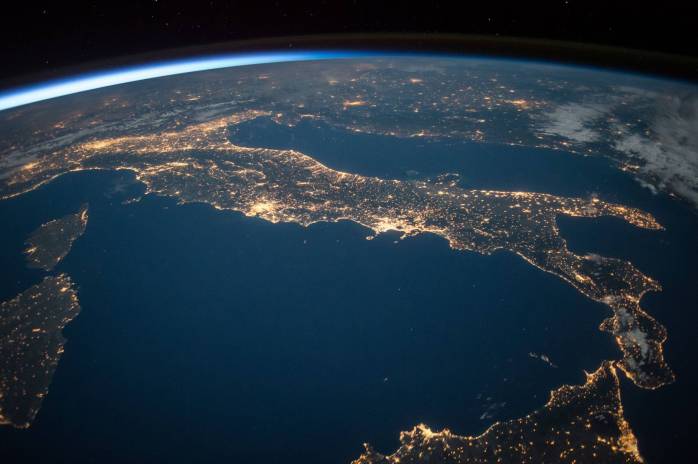
This element represents solidness. The earth is rigid, heavy and stable. It can hold something and stop something. This element influences our physique. Any decrease can lead to, for example, hair fall, weak teeth, brittle bones, bleeding and unstable relationship. On the other hand, excess may cause problems in digestion, lead to formation of tumors in the body and such like. Whereas, a perfect balance will bring good health, both mental and physical and also steady relationships.
AIR/WIND/PAVAN(Sanskrit), ALSO VAYU(Sanskrit)
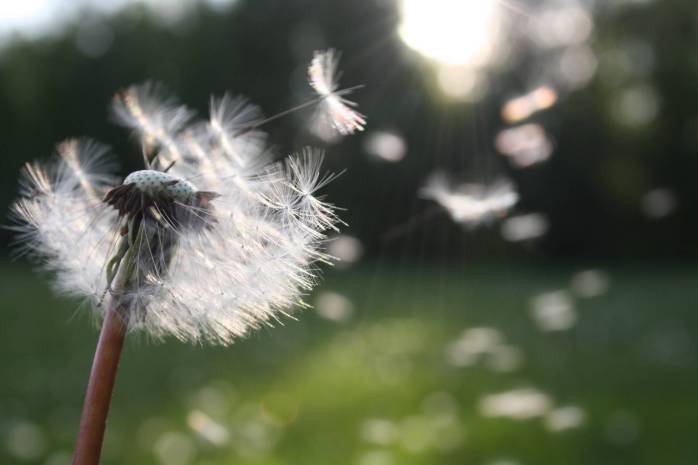
Air can be felt and heard only. One cannot see the air in the human body; the oxygen and carbon dioxide in the body refers to air. It is considered as one of the most important factors in Pranayama (https://en.wikipedia.org/wiki/Pranayama). Oxygen is Prana in Sanskrit. One must do regular Pranayama to keep body oxygen rich to prevent disease and decay.


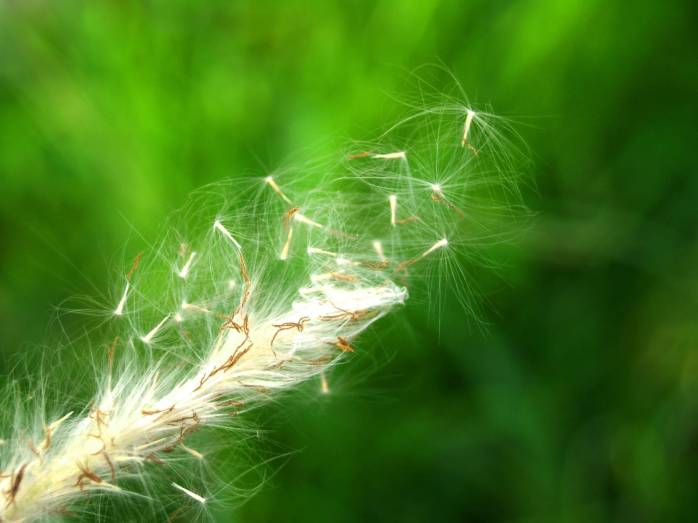


Air/Wind: There needs to be a perfect flow of this element for stability. This element signifies instability through movement between cold and dry (please refer diagram 2 above). Rapid movement may lead to mental fickleness, unstable relationships, twitching of muscles, and so on. Less wind may result in lack of ideas, low blood pressure, idleness, lack of life in relationships, irregular bowel movements and such.
FIRE/AGNI(Sanskrit)

In human body, the temperature (jatharagni (Sanskrit)) refers to fire. It can be heard, felt and seen. Our digestion system is one example of fire element, that helps our body to digest the food we consume everyday.
Fire can transform anything, solid to liquid, liquid to gas, etc. Heat is required for maturing, melting, cleaning and purification. Increase, of this element my lead to burning in chest, dark and burning urine, anger, aggression and such like. On the other hand, balance here may melt cysts, fibroids, osteophytes, and such like. While lack of fire, can reduce appetite, creativity, even warmth in one’s relationship.
WATER/JALA(Sanskrit)

This element has no odor(smell), but can be heard, felt, seen and tasted. In human body, blood and other fluids are referred to as water. As we all know, our body is made up of 60% water (adult body) and is very essential part of life.
This element represents wetness and coldness. Water can take any shape and is flexible.

It helps in lubrication and possesses cohesive properties. Excess of water may lead to swelling; it is also vital for relationships, as it represents adaptability and flexibility and influences adjustments and attachments.
HOW THE FIVE ELEMENTS MANIFEST
Each object and being in the universe contains a varying degree and combination of the five elements providing it’s unique features.
The English translation of the five elements do not give the full correct meaning of the original Sanskrit terms. The mahabhutas encompass much more than their given equivalents.
They refer not to the element itself, but to different densities of matter and different characteristics that they possess. The mahabhutas represent the physical qualities, energetic proportion and biological functions related to the given element. The mahabhutas originate from the subtle and all pervasive universal consciousness.
The density of the five elements increases from ether to air, to fire, to water, to earth. Ether is the most subtle of the five elements and has its origin from consciousness itself.
Our body which is made up of these five elements is sustained by our daily intake of food we consume, which in turn is again made up of these five elements. Natural substances, such as foods, herbs, minerals, sunlight, air and water are of the same composition as our structure and as such our bodies can utilize these in a harmonious way.
In a healthy body, the five elements are maintained in a particular proportion. When the state of the body is not in natural harmony, it will try to maintain equilibrium by eliminating excess elements and taking in others. All disorders in the body are manifested because of disturbances in this balance of the body’s components.
In addition to the five elements (mahabhutas), the body consists of eleven Indriyas (https://en.wikipedia.org/wiki/Indriya). The indriyas, include the five sense organs (ears, skin, eyes, tongue and nose), the five organs of action (vocal chords, hands, feet, genitals and anus) and the mind. Besides these we have Tanmatras (https://en.wikipedia.org/wiki/Tanmatras), which combines and recombines the five senses. Then there are Chakras (https://en.wikipedia.org/wiki/Chakra), focal points of our body.
My dear readers have understood, by now, that this is a very intricate study combining most of the secrets that have created this universe and our world and us. So without getting too deep into the various intricacies let us concentrate on the aim of this post: balancing of the elements for sound mental and physical health.
Let us once again look at what each element influences:

Earth: Bones, flesh, skin, tissue and hair.
Literally ‘earthing’: Grounding, calming, ego in check, regulates the energy of bones, muscles, tissues, controls hot illnesses such as infection.

Water: Saliva, sweat, blood, semen and urine.
Water provides the ability to adapt, flow, act selflessly and avoid unhealthy attachments. Water rules your blood and other bodily fluids and cold illnesses such as joint pains.

Fire: Hunger, thirst and sleep.
Fire brings confidence and courage, the energy of metabolism, drive and creativity. Excess can manifest in anger and hatred.

Air: Expansion, contraction and suppression.
Air is the channel for clear communication and self-expression. Influences one’s ability to act from a place of compassion and love. Jealousy occurs when out of balance.
Space: Physical attraction and fear.
Space is the container for all other elements, the source of intuition and wisdom from the universe and associates with expansion of the mind and liberation of the soul.
The techniques for preserving balance with the elements, comes through self realization. The three ‘R’s of Regulation, Routine and Rituals. Practice of yoga, pranayama, kriyas purify elements and restore balance. Self preparedness comes through the understanding of vastu(https://en.wikipedia.org/wiki/Vastu_Shastra), science of numbers, the effect of colors and the acceptance of the importance of all creation in this equation.
Our diet and weather conditions contribute to these elements. That’s where the science of ayurveda(https://en.wikipedia.org/wiki/Ayurveda) help us. Eating, right kind of food, according to the weather, balance our doshas/impurities. Consuming foods with with cooling properties, like curd in summer, definitely helps. Similarly, hot/spicy food would help in winter. Right quantities and not in extremes is the key.
Dear readers, it would be difficult to cover the means, tools and techniques in one article/post. Particularly because, requirements, circumstances would vary from person to person. Those of you, who have read my earlier posts, viz. The Icon and The Axis, would be in sync with the central theme. This post would definitely give an idea to any reader about the importance of the elements. However, I would recommend to reader’s, who are finding interest in the topics, to read the posts in sequence. All are welcome to write in with their queries and clarification and I would try and address them as best as I could from my own experiences and understanding.
It is time now to move on the the next post in the sequence, which is, The Word. Needless to add that it has a significant bearing on our lives.
Looking forward to your inputs.
LET US MEET AT OUR NEXT POST; THE WORD; UNTIL THEN PEACE!


 Nirvana