
Nirvana
Solitude – Solace – Serenity
THE PERSPECTIVE
What does life mean to each one of us? It could be different for different people. But most certainly it depends on how we look at life. This process of looking at life could fit in with our present topic and would broadly match the definition I have in my mind.
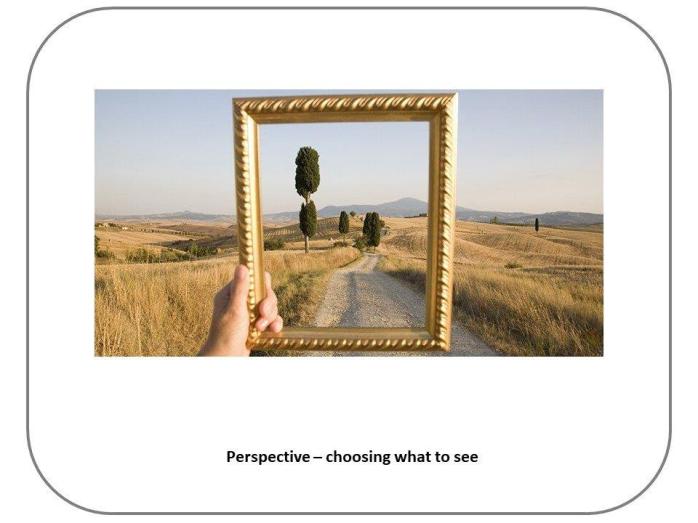
Life is action, growth, change and experience.
Life is belief, faith and relationship.
Life is intelligent, sorrowful and full of emotions, miracles, facts and regrets.
Pause to look at the mirror of your life. Were you able to consider things accurately and fairly? If not, it is for certain that you lacked perspective. Therefore, we derive the definition of perspective as the ability to consider things in relation to one another accurately and fairly. With maturity, one is expected to acquire perspective: when you read a classic as a child of 10, again at the age of 16 and again at the age of 25, you discover things you never found in your earlier readings! Why? You have moved on and have more information to consider the thoughts of the author anew and from a different perspective.
Let us, momentarily, consider what perspective would mean to an architect or artist.

The spot where the lines merge is called the ‘vanishing point’. All forms and matter in the image would converge to this point and would reduce its size from the foreground and would be in alignment with these imaginary lines. The buildings in this diagram, though of equal size, would become smaller and smaller as they go away from the foreground. Therefore, a child might say that the buildings in the distance are tiny, but a grown up would know the difference. Here lies the essence of perspective.
As Henry David Thoreau said: “The question is not what you look at, but what you see.” How you wish to label something you see is your perspective, which may or may not be the truth or reality. It is how we perceive things and arrive at a judgement or conclusion. The judgement could easily be influenced by the surroundings, exposure, knowledge, position, mindset, etc. and therefore could be distorted. Let us take a popular example:

One number drawn on the floor with two persons on either side. One sees six the other nine. Both of them are correct, yet they are wrong in the eyes of the other, because of their perspective of life. They could either stand and argue till the ‘cows came home’ or come around and sort out their thoughts.
The world would be a better place if we understood perspective of life and that this perspective could be molded, changed or explained. A lot of arguments, conflicts, misunderstandings, battles and even wars could be avoided if we could see things from another person’s perspective.
In the book The 7 Habits of Highly Effective People, first published in 1989, is a business and self-help book written by Stephen Covey. In this book the author has explained paradigm shift and how it happens. People’s perception changes in an instant when they connect with a reason for a certain behavior.
Perspective is our attitude or view related to a subject or thing. To accept the unseen, knowing the truth or to reserve forming an opinion until knowing the truth would be evidence of matured mindset. Conversely, believing your eyes, could be premature. Let us consider the image below:

While the image shows that the rails meet, in reality they don’t. Attitude, which is an aspect of perspective, is a way of thinking or looking at things. We have the ability to choose how we think. Therefore, you can alter your life by changing your attitude. Attitudes are often the result of experience or upbringing, and they can have a powerful influence over behavior.

Differences with people you interact with do not help. To know what is pleasing and loving, obeying and respecting. The off-shoot of being different would require fine tuning of obedience, pleasing others, respect and respecting. Complaining about things around you, again is of no help. Complaining, literally shrinks your brain. Reframing negative thoughts would need a change of ‘perspective’. Solution oriented complaining would be a positive attitude.
Making a difference is another angle to the term ‘difference’ considered in the paragraph above. Mahatma Gandhi echoed the teachings of Gita, “It’s the action, not the fruit of the action, that’s important. You have to do the right thing. It may not be in your power, may not be in your time, that there’ll be any fruit. But that doesn’t mean you stop doing the right thing. You may never know what results come from your action. But if you do nothing, there will be no result.” I would like to add another longish quote to highlight this connotation of difference :
“Once upon a time, there was a wise man who used to go to the ocean to do his writing. He had a habit of walking on the beach before he began his work.
One day, as he was walking along the shore, he looked down the beach and saw a human figure moving like a dancer. He smiled to himself at the thought of someone who would dance to the day, and so, he walked faster to catch up.
As he got closer, he noticed that the figure was that of a young man, and that what he was doing was not dancing at all. The young man was reaching down to the shore, picking up small objects, and throwing them into the ocean.
He came closer still and called out “Good morning! May I ask what it is that you are doing?”
The young man paused, looked up, and replied “Throwing starfish into the ocean.”
“I must ask, then, why are you throwing starfish into the ocean?” asked the somewhat startled wise man.
To this, the young man replied, “The sun is up and the tide is going out. If I don’t throw them in, they’ll die.”
Upon hearing this, the wise man commented, “But, young man, do you not realize that there are miles and miles of beach and there are starfish all along every mile? You can’t possibly make a difference!”
At this, the young man bent down, picked up yet another starfish, and threw it into the ocean. As it met the water, he said, “It made a difference for that one.”
― Loren Eiseley
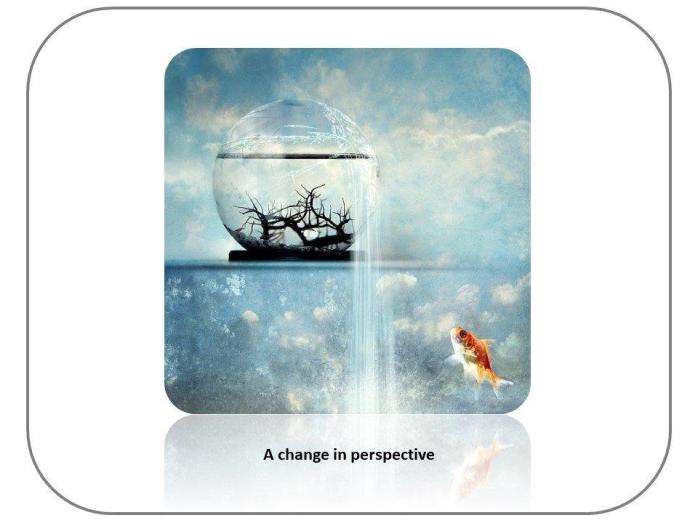
When you go through hardships and do not give up, your struggles develop your strength. Therefore, strength doesn’t come from winning but through struggle. Success doesn’t come to those who run fast, but to those who keep running. The determination to keep going builds one’s strength. Thriving in the face of adversity is the key to life. There is a need for changing our perspective.
It is said that gratitude is perhaps the most powerful human emotion. It is most certainly a way to keep anxiety at bay and shut the door on depressing thoughts. Humans are social animals and there is necessity of bonding. Gratitude is the best cementing agent known for social bonding. With gratitude comes appreciation. If one doesn’t take life for granted but as a gift, gratitude and appreciation automatically make an appearance in the psyche. The transformation in perspective is bound to take place as it helps in recognizing the positive side of life.

Work-life balance refers to the level of prioritization between personal and professional activities in an individual’s life. It is the state of equilibrium in which demands of personal life, professional life, and family life are equal. Obviously this leads us to prioritization of our priorities. In other words, a change or fine tuning our perspective of life.
We realize then that a change in perspective helps to improve our life from every angle if applied correctly. Whether it is at home or at work, whether it is relating to health or relationships, the right perspective would remove the shortcomings and bring the required understanding to appreciate what needs tweaking and how best to go about it.
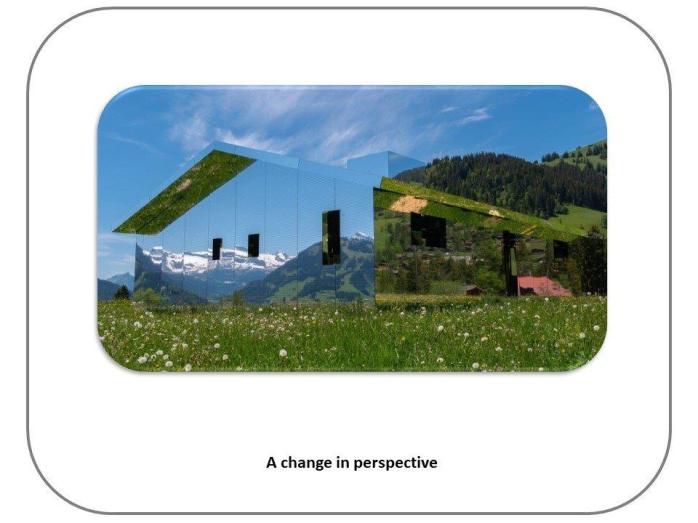
The objective of appreciating the perspective of life is to render you to explore your highest potential through powerful processes of self transformation, to address key aspects of life and access the secrets of ancient wisdom through constant dialogue with your own conscience. Those who have learned a little of the Ancient Wisdom know the illumination, the peace, the joy, the strength, it’s lessons have brought into their lives.
Here are two quotes from Mahatma Gandhi, “Truth is what the voice within tells you”; “The dignity of man requires obedience to a higher law, to the strength of the spirit”. What did he mean? Building your “spiritual strength” activates your spirit and connection to the divine from within, giving you the power you need to live a life of purpose and fulfillment. “Everything is within your power, and your power is within you.” ― Janice Trachtman.
Love as a constant attribute of the being, loving everything, everyone, caring and sharing and without any distractions builds strength of spirit and helps in appreciation of the universe as it is unfolding. To remember that the universe is unfolding as it should.
Dear readers, before I move on, I would very much like to read/hear your thoughts. Trust you have read my posts in sequence for a better grasp of my thought process and to understand my experiences.
Let us meet at our next post: THE VIRUS; until then peace!


 Nirvana
“Excellent” is an adjective falling a little short to describe the blog I just read … it answered quite a few questions & then raised some new ones – but one thing is for sure, it would engage my mind for days in a conversation with myself.
Good wishes …
LikeLike
Grateful for your kind comments. Please share the questions that were answered and those that cropped up to help me in my journey towards self awareness. Regards.
LikeLike