
Nirvana
Solitude – Solace – Serenity
THE TREE BAOBAB
I was fortunate to live in Southern Africa for over a decade and during this time was very taken by this tree named Baobab.
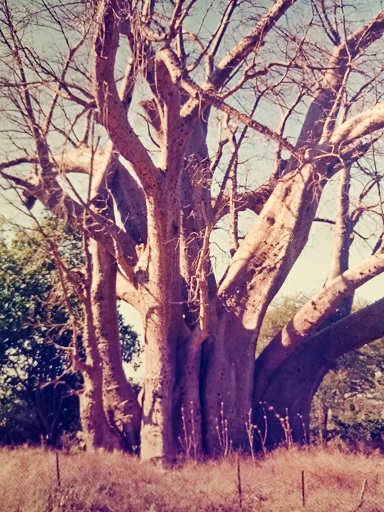
The tree looks dead, but it is very much alive! Africans call it the Tree of Life and for good reasons too! In former times baobabs were used for shelter, water storage or as prisons in Namibia, Botswana, and other countries. The tree shown above was used as a prison cell. This tree in Kasane was used as a prison for a long time. Offenders were imprisoned and held there before they were relocated to other prisons. The tree is still there and alive but it has changed its structure over the years. The main stem with the prison cell has split up in several spots and cannot be used as a prison any more.
We shall look at another example. Notice the contrast.
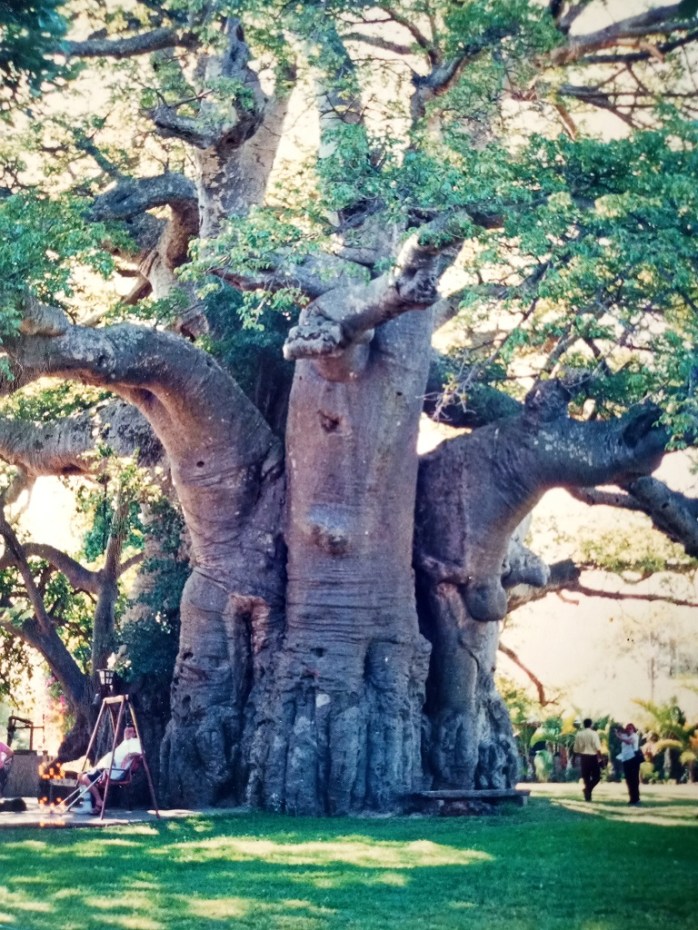
You will be surprised to know that there is a bar inside the trunk of this massive Baobab! Amazing contrast between the two photographs, isn’t it? Notice the people in contrast to the the tree, to understand the sheer size of the span of it’s diameter. This tree is located in the Tropical Rain Forest of South Africa. The Tropical rain forests is roughly located within 28° north or south of the equator. They are hot and wet. South Africa’s only rainforest rests on the edge of the Crocodile River on the outskirts of Nelspruit, in a place so unlikely that hardly anyone knows it exists.
It wont be fair on the readers, if I skip to mention two very interesting information pertaining to this region of South Africa, viz., The Cycads (https://en.wikipedia.org/wiki/Cycad) and the Rain Queen(https://en.wikipedia.org/wiki/Rain_Queen).
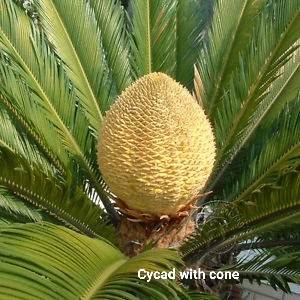
Cycads date back 280 million years. They have a trunk, leaves and cones, all of which are covered with stiff, sharp spines. Cycads will either be male or female in gender and when they are in a reproductive condition they bear large cones. South Africa has some of the rarest cycad species in the world. The government has to take strict measures to save them from poaching.
The Modjadji, or Rain Queen, is the hereditary queen of Balobedu, a people of the Limpopo Province of South Africa. The succession to the position of Rain Queen is matrilineal, so her eldest daughter is the heir, and males are not entitled to inherit the throne at all.(Source Wikipedia). The queen-to-be is 16-year-old Masalanabo Modjadji, who will officially be crowned Queen Modjadji VII, the “Rain Queen”, when she turns 18 in 2023. The Rain Queen’s mystical rain making powers are reflected in the lush garden, that surrounds her royal compound.
Now coming back closer to home. Not very far from where I live, in Shibpur Botanical Gardens, Kolkata (previously Calcutta), there is a 100 year old specimen weighing approximately 30 tons. It is famously known as the Kalpavriksha (https://en.wikipedia.org/wiki/Kalpavriksha) or a tree with which one’s wishes come true. The lore goes that many a wish was fulfilled by this tree over the years.
These Baobab trees are sturdy and lives for about 500 years. It is known for medicinal properties. It’s bark is the source of amino acids and minerals and are used in mineral supplements .
Coming back to Kalpavriksha, which has a lot of historical, holy and religious significance in India. Also known as kalpataru, kalpadruma or kalpapādapa, is a wish-fulfilling divine tree in Hinduism, Jainism and Buddhism.
It is by sheer chance that a Baobab tree has been identified as a Kalpavriksha, giving me an opportunity to elaborate on this phenomenon. Lore has it that anyone making a wish with such a tree, would have the wish granted. Let us consider a scenario. When living in Gaborone, the capital of Botswana, I was surprised to note that majority of my colleagues had never set their eyes on a lion in their lives; where as tourists from all over the world travel to these parts to experience the sighting of these majestic cats. There were many locals who would have been thrilled to have this experience. Now, in a hypothetical scenario, let us presume that one such person is in the presence of a Kalpavriksha/Wish-fulfilling tree. The wish is that to see a lion – lo and behold: a majestic specimen right in front of him/her. The wish is fulfilled!
Now that the wish is fulfilled, there is no guarantee about the lion’s next move! Is it going to go away or charge at the person in front of him? This is a very pertinent and important question in all our lives!!! Dear readers, I would urge you to give this hypothetical scene a considered and soul-searching thought. Many a times, all of us wish for things, both material and otherwise. It could be objects or it could be relationships. Most certainly, we wish for the best and fantasize of the pleasures that would follow, without knowing what the granting of that wish would entail. Will it bring happiness or despair?! Even in real life, the above scene has unfortunately occurred, when tourists from far and wide have lost their lives to wild animals while on holidays.
We have to be very cautious about our wishes. All pros and cons needs to be weighed. Particularly so, if you have not made the ‘connection’ (with reference to my earlier post: The Connection). If you have, you are happy to leave the choice and decision to Him!
Time now to narrate an anecdote I heard from a sadhu, which I later found in print as well.
A man while taking a walk came across a beautiful mango orchard. He saw ripe mangoes hanging from the branches, within easy reach. Now you be the judge. It was the eyes which saw the mangoes. If the man was blind, he would not have seen them. Who took him to the orchard? His legs and feet. Could the eyes have taken him there? So, the one (the eyes) who saw the mangoes couldn’t go, whereas the ones (the legs) who didn’t see went. Now the one who saw and the ones who took the man to the orchard would not know how to pluck the mangoes without the help of the hands. So the eyes saw, the legs went and the hands plucked. Now, could the hands taste the mangoes and say whether they were sweet or sour? So the tongue had to do it. Yet the tongue after tasting could not keep it. The same was retained by the stomach.
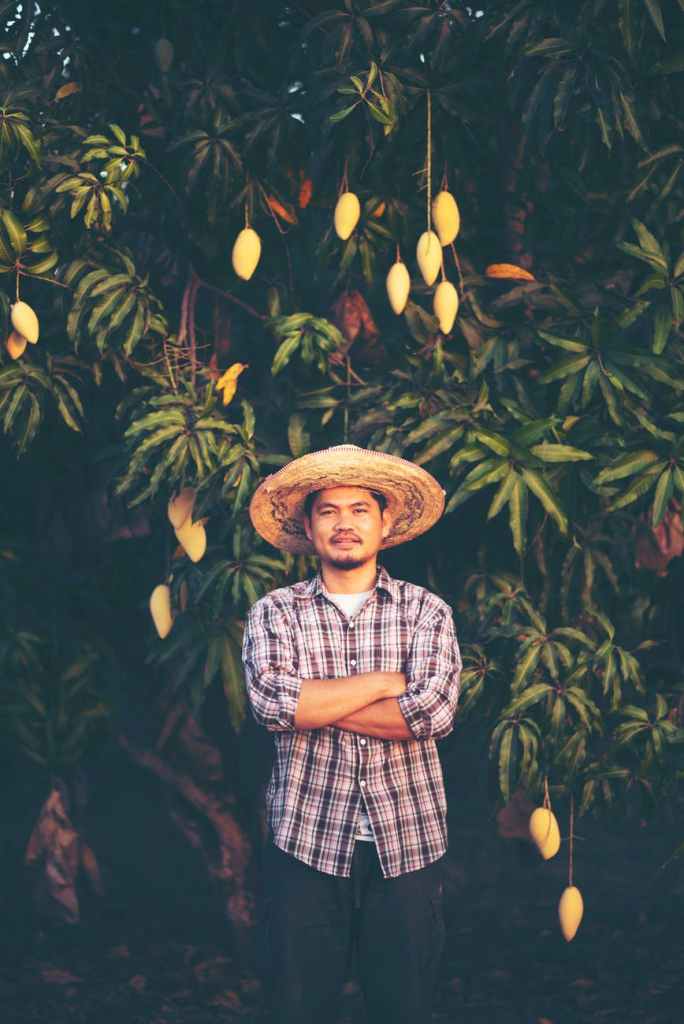
In the mean while, the gardener who witnessed the theft, came with a stick from behind and landed two or three blows on the back of the person. Tell me, what was the back’s fault? The back was no way involved in the entire process of seeing, arriving, plucking, tasting and eating; yet he suffered the blows. But wait, there is justice! So with the pain of the blows, who cried? The eyes!!! Therefore, originally the organ which committed the crime paid with tears.
What is the lesson we take from the above story? There is much more than the what meets the eye! Dear readers, do fill in with your thoughts on the above.
Moving on, we shall consider another scenario. I procured myself a set of three frying pans, together with lids to cater to all my frying needs. After every use, however greasy and dirty they might have been, I took care to thoroughly clean them and store them in sparkling state for my next use. Over time, the one which was most used, lost its original shine and didn’t look as clean as the other two.
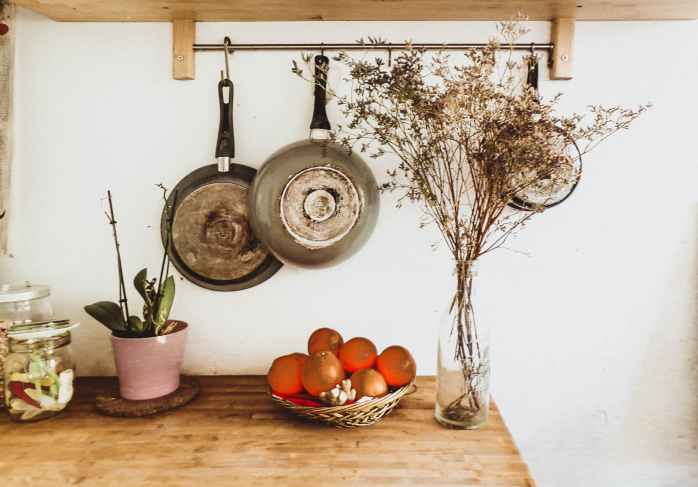
And then I started carrying the smallest one for my treks. Soon, this one also looked more used and started resembling the frequently used pan. Later, with constant beating that it took outdoors and with use at numerous camp fires, it didn’t look like a pan from the set of three bought together at the same time.
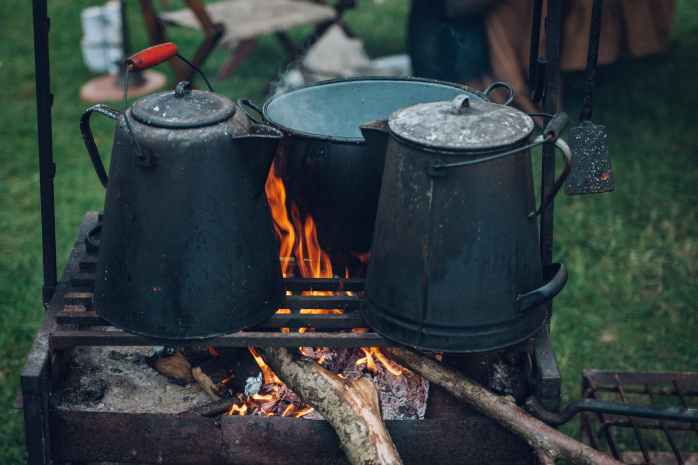
Let us for a while imagine that the our body is the kitchen and the frying pans are three of our vital organs, say, heart, kidney and lever. Or any other as per your choice. As long as we are conscious and pay attention to our body and all that makes it run smoothly from day to day, there is no concern. If we overuse or neglect, by indifference, ignorance or inadvertently, the result would be similar to the frying pans. We can carry this analogy very very far and to very minute details.
Would any or some of my readers help taking this narrative forward? You could use the feedback form or communicate directly to my email: selfengineerbaobab@gmail.com. I am looking forward to your inputs.
Those of who have read the Stephen Covey book, The 7 habits of highly effective people, would be reminded of the last and seventh habit: Sharpen the saw. It is very much possible to maintain a clean and sharp mind and body by being conscious. Knowing when to draw the line, understanding abuse, being informed, devoting time and making sacrifices as required.
I am in no way advocating that one has to give up their favorite food, stop drinking, smoking and turn into a hermit. Instead, one must know how much, when and in what quantities. Awareness of the effects of food drink or whatever we consume and their retention in our system, depending on our metabolism is necessary. Otherwise, yes, one has to go without them and get into the sacrifice mode. It has been repeatedly stated that alcohol, smoking and various other items consumed in our daily lives, are harmful. No doubt that they are. Yet, there are numerous examples of people living long and healthy lives through conscious and regulated lifestyle even after indulging. If one is consuming alcoholic drinks, his/her head needs to be clean from fumes to function at its peak. Rich food may entail discomfort and indigestion and may interrupt performance. Regular bowel movement and cleaning of the system ensures peak conditioning of mind and body.
What are vital requirements of life? Air, water, food and sunlight. Translate to oxygen, nutrients and conducive temperatures. Not to forget sunlight or energy. Next, what are our vital organs? Skin, brain, heart, kidneys, liver, pancreas, stomach, intestines and lungs. How to keep our vital organs healthy and working in perfect order?
Simply put in one word, awareness! Knowledge about ourselves and how we function and what makes us tick. How to discover equilibrium in the midst of chaos. Self discovery. Dear readers, we shall delve more and more into these areas of life as we go along. Trust that you have read my posts in sequence, i.e. starting with The Icon, The Axis, The Elements, The Word, The Connection, The Virus and the current one The Tree Baobab. This brings to the conclusion the first part of my journey with you all.
Looking forward to hearing from you all and continuing where we left of. Until then PEACE.


 Nirvana